
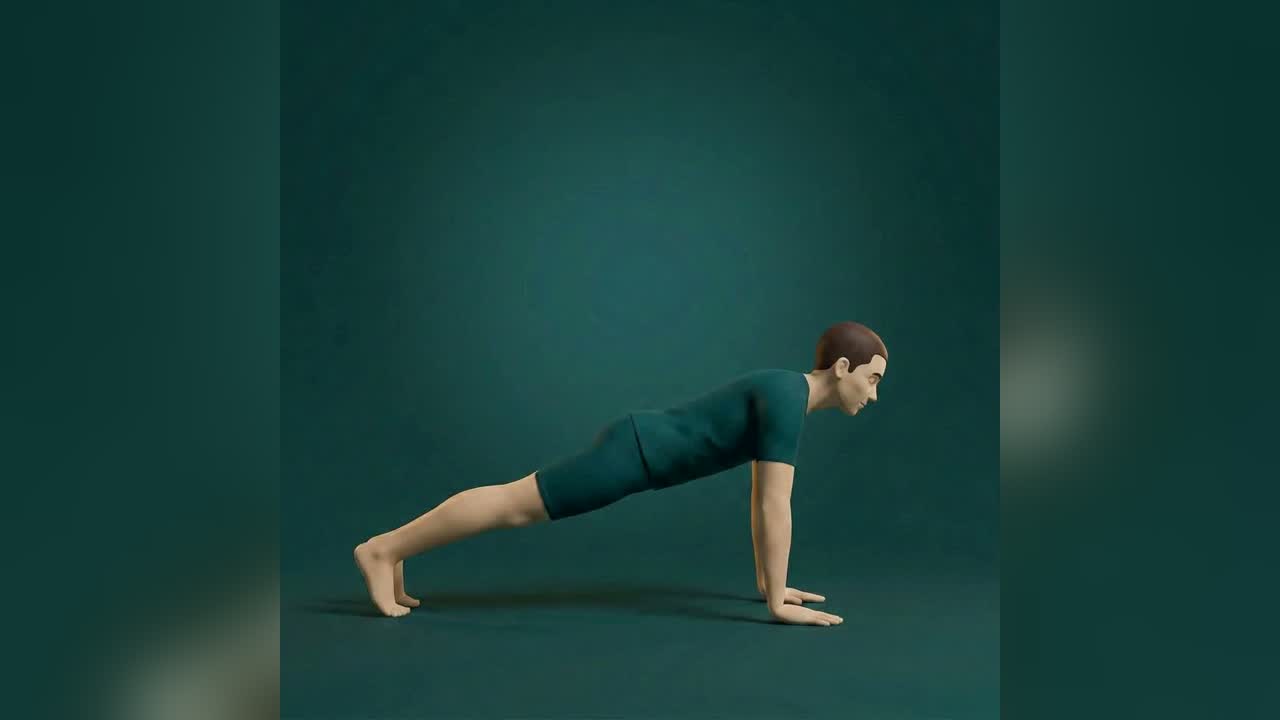
Push-Up & Pressing: The Underrated Powerhouse Without Equipment
The 30-second answer
Pressing is one of the five fundamental patterns — and the push-up is its best equipment-FREE implementation: in comparison studies, progressive push-up training built strength and muscle comparably to bench pressing at matched muscle activity. The trick is the right rung: from the wall via elevated hands to elevated feet, there is a variant for every level that allows 8–15 clean reps. If push-ups are "all" you train, you are training right.
The key points at a glance
| Area | Evidence | Statement |
|---|---|---|
| Chest, shoulders, triceps | A | Randomised comparisons show: push-up variants with appropriate resistance achieve similar strength and muscle gains as bench pressing — what matters is the load relative to your level, not the equipment. |
| Core included for free | B | Unlike the machine, the push-up is simultaneously a moving plank: trunk and glute tension hold the body line — two exercises for the price of one. |
| Fitness marker | B | In a much-cited cohort study of firefighters, higher push-up capacity was associated with markedly fewer cardiovascular events over 10 years. That is observation, not proof of causation — but a strong hint that this simple test says a lot about overall fitness. |
| "Push-ups are only for beginners" | — | Honest no: with elevated feet, added weight, tempo variations and one-arm progressions, the push-up scales to a level most gym-goers never reach. "Too easy" is always a rung problem, never an exercise problem. |
| A substitute for all pulling | — | Clear limit: pressing trains the front. Without pulling exercises (rows, pull-up progressions) an imbalance develops — no shoulder thanks you for that long term. Push and pull belong in the programme together. |
Evidence grades: A = strongly supported · B = supported in the right context · C = emerging/mixed evidence · D = experimental · — = no proven benefit. Quoted statements with a regulation number are officially reviewed health claims authorised by the EU — we use only those.
Why the push-up outclasses its reputation
The push-up suffers an image problem: too available to seem valuable. Research disagrees. In a randomised comparison, push-up training at matched muscle activity produced similar strength gains to bench pressing; another study showed that progressive push-up training also builds measurable muscle thickness. The body does not distinguish between a bench and a living-room floor — it responds to tension, load and progression.
Add the famous finding from cardiology: among more than 1,100 firefighters, being able to do over 40 push-ups was associated with a drastically lower risk of cardiovascular events over ten years compared with fewer than 10. Honestly framed: that is an observational study in a specific group — push-ups do not causally "protect" the heart, but the capacity is evidently a remarkably good marker of overall condition.
Technique: the plank line is half the exercise
- Body line: head, back and pelvis form one board — glutes tensed, abs braced. The sagging hip is the most common error and turns the exercise into a lower-back stress test.
- Hands about shoulder width, under the shoulders; the elbows travel diagonally back on the way down (roughly 45 degrees to the torso), not flared out like wings.
- Full range: chest toward the floor, full lockout at the top. Half reps count as everywhere: half.
- Controlled tempo: 2 seconds down, brisk up — momentum is borrowed strength that is missing from the building process.
Dose it, as always, with the RPE principle: the variant is right when 8–15 clean reps with 2–3 in reserve are possible.
The progression ladder: a rung for every level
- Rung 1 — wall push-up: standing against the wall. The right start with little strength, higher body weight or after a long break.
- Rung 2 — elevated push-ups: hands on a table edge, kitchen counter or bench — the lower the support, the harder. This rung carries most people for months.
- Rung 3 — knee push-up: classic and fully legitimate — or continue directly with ever-lower elevations, which preserves trunk tension better.
- Rung 4 — full push-up: the milestone. Whoever manages 15 clean ones here picks the next rung.
- Rung 5+ — make it harder: elevate the feet, backpack with weight, slow tempo (3–5 seconds down), pauses at the bottom, narrow hand position for more triceps.
The rule for changing rungs: only when the current rung becomes clean in the upper rep range does the next one come — exactly how our app plans it, setting the push pattern to your level automatically (the form check shows the execution on video).
The balance question: pushing needs pulling
As good as the push pattern is — left alone it becomes a problem: strengthen only the front and over time you breed the forward-pulled desk shoulder you meant to fight. The rule of thumb: for every pushing set, at least one pulling set — table rows, band rows or pull-up progressions. Together with the squat and hip hinge, the push-pull pair is the core of every balanced programme.
And the usual limit: wrist pain can often be solved with handles or fists; shoulder pain during pressing, however, is a stop signal — get it checked medically or by a physiotherapist if it recurs.
Sources
- 1. Calatayud et al. — Bench press and push-up at comparable muscle activity: similar strength gains (JSCR 2015) — Accessed on: 2026-08-21
- 2. Kotarsky et al. — Progressive calisthenic push-up training: muscle strength and thickness (JSCR 2018) — Accessed on: 2026-08-21
- 3. Yang et al. — Push-up capacity and future cardiovascular events among active men (JAMA Netw Open 2019) — Accessed on: 2026-08-21
Dietary supplements are not a substitute for a balanced, varied diet and a healthy lifestyle. This article is for information purposes only and does not replace medical advice.