
Pulling & Rowing: The Antidote to Desk Posture
The 30-second answer
Pulling trains everything the desk lets wither: upper back, rear shoulder, biceps and grip. The rule of thumb for every balanced programme: at least one pulling set per pushing set. And it works without a gym — the inverted row is one of the best-studied variants: high muscle activation at low spinal load. The first pull-up is not a talent event but the end of a plannable ladder.
The key points at a glance
| Area | Evidence | Statement |
|---|---|---|
| Upper back & rear shoulder | A | Electromyography studies confirm: rowing and pull-up variants strongly activate the lats, trapezius portions and rear shoulder — exactly the musculature the forward-hunched desk torso is missing. |
| Balance to pushing | A | Training logic, not taste: whoever pushes must pull — otherwise the force balance at the shoulder tilts toward the front chain over months. The 1:1 rule (one pulling set per pushing set) is the simplest insurance. |
| Back-friendly variants | B | The comparison measurements by Fenwick and colleagues show: the inverted row generates high trunk and pulling-muscle activation at comparatively low lumbar spine load — ideal for beginners and anyone with a back history. |
| "Pull-ups are not for me" | — | Honest no: the pull-up is a question of the ladder, not of talent — via band assistance and slow negatives it is reachable for most people. It is just not a starting point but a milestone. |
| Posture "repair" in fast-forward | — | Honesty limit: pull training strengthens the postural musculature and many people feel more upright with it — a four-week miracle cure for years of sitting it is not. It works the way training always works: over months. |
Evidence grades: A = strongly supported · B = supported in the right context · C = emerging/mixed evidence · D = experimental · — = no proven benefit. Quoted statements with a regulation number are officially reviewed health claims authorised by the EU — we use only those.
Why the pull pattern goes missing so often
The pull pattern has a visibility problem: pushing and leg muscles show in the mirror, the upper back does not. Add the equipment prejudice — push-ups need nothing, pulling seemingly needs a bar. The result is the classic "mirror programme": strong in front, forgotten behind. Yet pulling is one of the five fundamental patterns (all in the form check) — and functionally the direct counter-programme to the most common posture of modern life: bent forward over a screen.
The progression ladder: pulling without a gym
- Rung 1 — band rows seated/standing: resistance band around a stable anchor (door hook, railing), pull the elbows close to the body toward the belly, deliberately draw the shoulder blades together. The lowest-threshold entry.
- Rung 2 — table rows (inverted row): lying on your back under a sturdy(!) table or a low bar, body as one board, pull up to the edge. The more upright the body angle, the easier — difficulty is continuously adjustable. The measurement data is strong: lots of activation, little lumbar load.
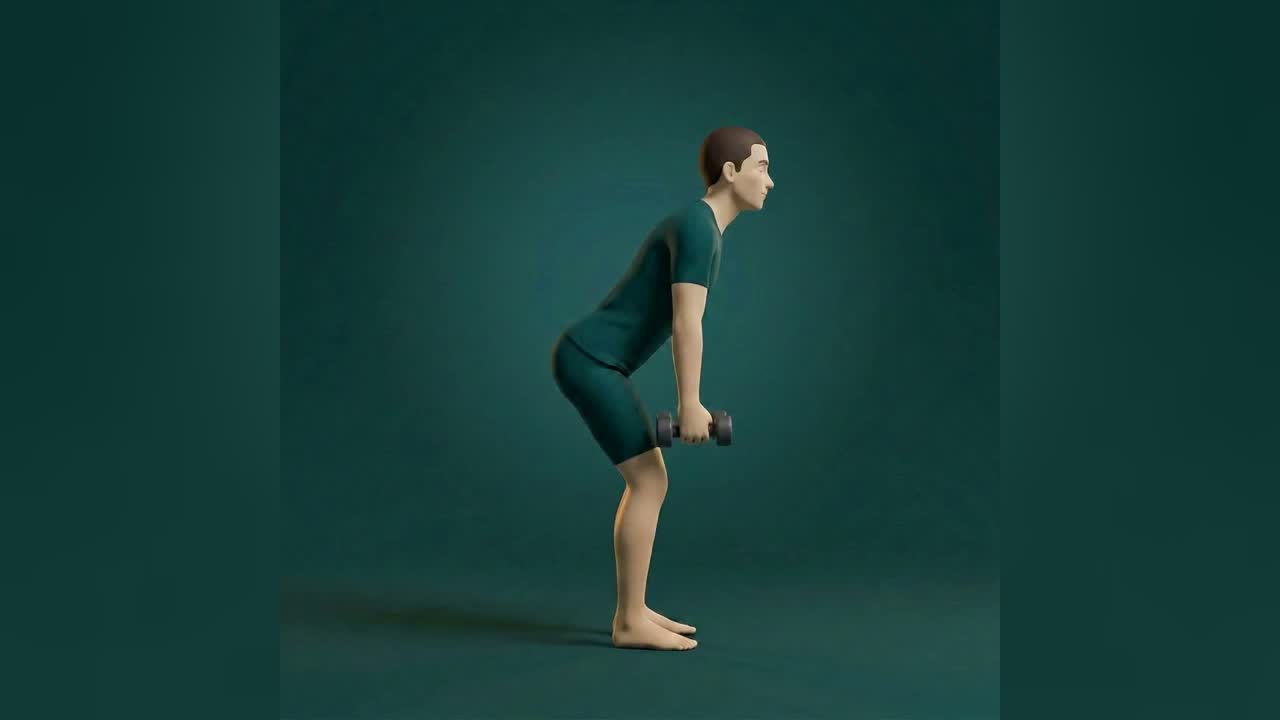
- Rung 3 — one-arm dumbbell/backpack rows: one hand supported (bench, chair), long back line, pull the weight toward the hip. Here the pull pattern becomes heavily loadable.
- Rung 4 — pull-up progressions: negatives (jump or step up, lower under control for 3–5 seconds) and band-assisted pull-ups — the two proven roads to the first full pull-up.
Dose it with the RPE principle; as the programme anchor, the balance rule from the pushing article applies: at least one pulling set per pushing set.
Technique: the three points that count
- Shoulder blades start: the movement begins by drawing the shoulder blades together, then the arms follow — pull with the biceps alone and you give away the back.
- Elbows close to the body toward hip/belly, not flared out at shoulder height — that keeps the shoulder in its strongest zone.
- No momentum, no trunk rotation: the body stays the board (table row) or the long line (one-arm row). Momentum shifts the work from muscles into joints.
And as everywhere: pain beyond muscle burn — especially sharp shoulder pain — is a stop signal and, if recurring, a case for medical or physiotherapy assessment.
The road to the first pull-up — realistically planned
The pull-up is the symbol of "real" fitness for many — and rarely fails on strength alone, but on the missing plan. The proven route: first build rowing volume (several weeks of table rows and one-arm rows until clean 3×10), then negatives (2–3 times per week, 3–5 reps of 3–5-second lowering), band pull-ups in parallel with ever-thinner bands. The EMG research adds a useful detail: the underhand grip (chin-up) activates the biceps more and is the easier entry for most — entirely legitimate; the overhand version can follow later.
Honest time horizon: weeks to many months depending on starting point and body weight — progress here is measured in seconds (longer negatives) and band thicknesses, not in days. Exactly the kind of trajectory the yesterday comparison was built for; our app sets the pulling rung automatically to your level.
Sources
- 1. Fenwick, Brown & McGill — Comparison of different rowing exercises: trunk activation, lumbar load (JSCR 2009) — Accessed on: 2026-08-21
- 2. Youdas et al. — EMG activation patterns during pull-up, chin-up and variants (JSCR 2010) — Accessed on: 2026-08-21
- 3. Martín-Fuentes et al. — EMG systematics of pulling/lifting exercises (PLoS One 2020, posterior chain context) — Accessed on: 2026-08-21
Dietary supplements are not a substitute for a balanced, varied diet and a healthy lifestyle. This article is for information purposes only and does not replace medical advice.