
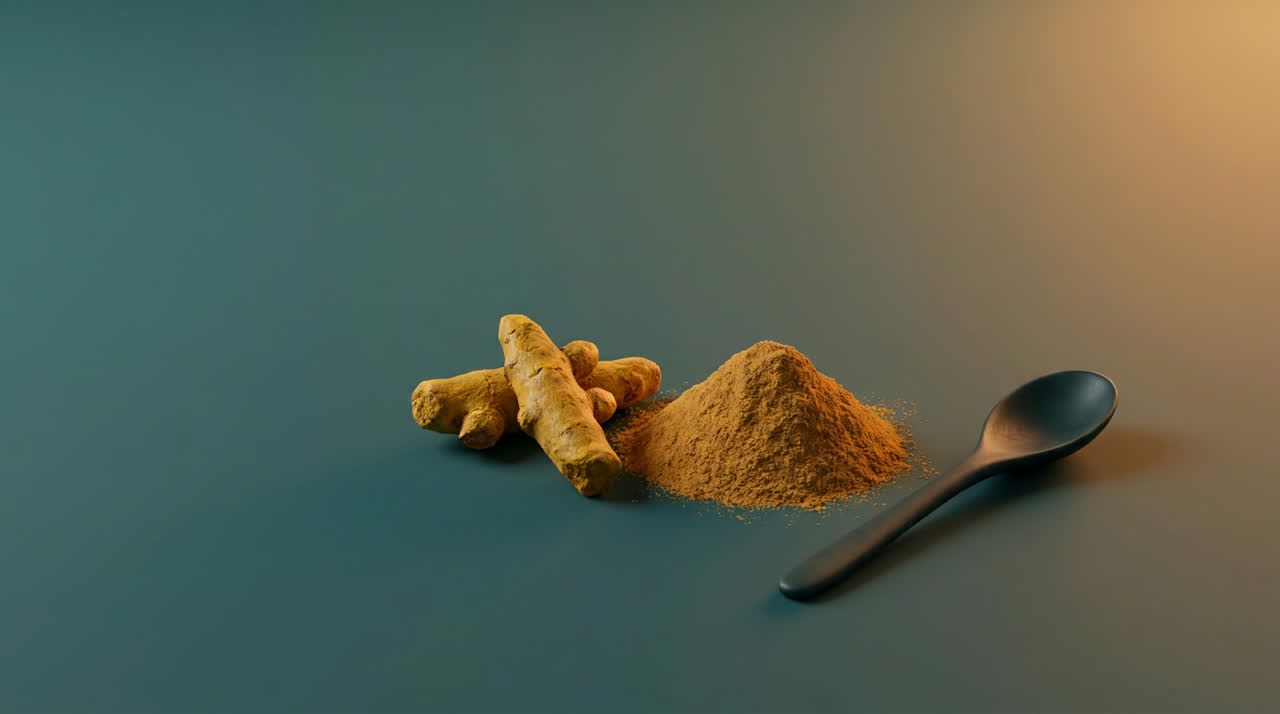
Turmeric & Curcumin: The Golden Promise, Fact-Checked
The 30-second answer
Turmeric in a curry: wonderful. Curcumin in a capsule: a story with two uncomfortable truths. First, the body barely absorbs curcumin and breaks it down at speed — which is why the industry adds enhancers like piperine. Second, it is precisely with these high-bioavailability preparations that liver injury cases are documented internationally. Against that stand, at best, weak signals of joint symptom relief — and to pharmaceutical chemistry, curcumin is a notorious "false friend" that seems to do everything in lab screens and reliably disappoints in solid clinical trials.
What does it actually do for you?
| Area | Evidence | Statement |
|---|---|---|
| Joint complaints (osteoarthritis) | C | The strongest area: a 2024 umbrella review confirms consistent signals for pain and function improvement in knee osteoarthritis, in the ballpark of painkillers — with study quality still mixed, short duration and frequent manufacturer involvement. A 2025 network meta-analysis gives an honest ranking: Boswellia outperformed curcumin in direct comparisons. A trial for osteoarthritis is defensible — with realistic expectations and the safety rules below. |
| Bioavailability | — | The core problem, honestly named: curcumin is barely absorbed, rapidly metabolised and rapidly excreted — the review by Anand and colleagues has documented this since 2007. What works in the test tube hardly reaches the target cell in humans. |
| "Anti-inflammatory miracle" & cancer/Alzheimer hopes | — | The medicinal chemistry analysis by Nelson and colleagues is blunt: curcumin is chemically unstable and a classic lab-screening troublemaker (PAINS) — it "works" on almost everything in cell assays and, despite thousands of studies, has delivered no convincing double-blind clinical confirmation. Big promises without clinical cover. |
| Authorised EU claims | — | As with almost all botanicals: no authorised health claim — turmeric claims sit in the "on hold" pile, nothing is authorised. Every "anti-inflammatory" statement on a package stands on thin legal ice. |
| As a spice in the kitchen | B | The most relaxed verdict: as a spice, turmeric is harmless, delicious and part of a vegetable-rich kitchen — just a spice, not a medicine. If you love turmeric, cook with it; the cooking pot provides no reason for a capsule. |
Evidence grades: A = strongly supported · B = supported in the right context · C = emerging/mixed evidence · D = experimental · — = no proven benefit. Quoted statements with a regulation number are officially reviewed health claims authorised by the EU — we use only those.
Why the evidence base is so large and so empty at once
Curcumin is a paradox: tens of thousands of publications, hardly any robust clinical wins. Medicinal chemistry supplies the explanation. Nelson and colleagues described curcumin as the textbook example of a compound class that systematically produces false-positive hits in lab screens (PAINS — pan-assay interference compounds): it is chemically unstable, coloured, fluorescent and membrane-disrupting — which makes it appear to "work" on almost every assay in the test tube. Add the absorption problem: the review by Anand and colleagues documents that orally taken curcumin reaches the blood only in traces and is broken down quickly.
Together this explains the pattern: spectacular cell and animal data, disappointing clinical trials. Where positive human studies exist (mainly joint complaints), they are small, short and often manufacturer-adjacent — exactly the sort of evidence that tends to shrink on independent replication.
The piperine trick — and its price
The industry's answer to poor absorption: enhancers. Black pepper extract (piperine) can drastically raise measurable curcumin uptake; modern formulations (micelles, phospholipids) take similar routes. Sounds clever — but has two catches. First, piperine does not disable metabolism only for curcumin: it can also alter the breakdown of medications and raise their levels uncontrollably. Second, the rise in documented liver injury cases internationally coincides conspicuously with the spread of precisely these high-bioavailability preparations — the US National Institutes of Health LiverTox database now lists turmeric/curcumin with its own case series, and Italian authorities investigated a whole cluster of such cases.
The bitter irony: the better a preparation solves its bioavailability problem, the more serious its safety question becomes — while the proof of benefit remains outstanding.
If you want to try it for joint complaints
For the one halfway plausible use case — symptom relief in osteoarthritis — a tight frame applies: a time-limited trial (6–12 weeks) with an honest before-and-after audit, as a complement and never a substitute for what demonstrably works (training, weight management — the osteoarthritis dossier explains why). No ongoing consumption without proof of benefit in your own body, no combination with the risks listed below — and at the first sign of liver trouble (dark urine, yellowing, persistent nausea) stop immediately and get medical evaluation.
And consequently: because of the open safety questions around enhanced preparations and the missing claim basis, we link no products in this article.
Safety & dosing
- Dosing
- As a spice: harmless, to taste. As a preparation: if at all, a time-limited trial for joint complaints with an honest audit — no ongoing use without a noticeable benefit. With medication or pre-existing conditions, clarify medically first.
- Upper limit
- For curcumin an EFSA ADI exists (up to 3 mg/kg body weight/day) — high-dose, bioavailability-enhanced preparations can clearly exceed that magnitude. "Plant-based" is not an upper limit.
- Interactions
- Liver: documented case series of liver injury, clustered around piperine-/high-bioavailability preparations — with dark urine, yellowing or persistent nausea, stop immediately and seek medical evaluation.
- Piperine-containing products: can alter the breakdown of medications (incl. anticoagulants, antiepileptics, some cardiac and cancer drugs) — with any permanent medication, ask your practice or pharmacy first.
- Anticoagulants: possible effect amplification — caution.
- Gallstones/biliary disease: curcumin stimulates gallbladder contraction — do not take.
- Pregnancy and breastfeeding: avoid preparations (spice amounts are unproblematic); high doses can additionally inhibit iron absorption.
Discuss dosing and suitability for you with a doctor or pharmacist.
Sources
- 1. Anand et al. — Bioavailability of curcumin: problems and promises (Mol Pharm 2007) — Accessed on: 2026-08-21
- 2. Nelson et al. — The essential medicinal chemistry of curcumin (J Med Chem 2017, PAINS analysis) — Accessed on: 2026-08-21
- 3. NIH LiverTox — Turmeric/Curcumin (documented liver injury cases) — Accessed on: 2026-08-21
- 4. EU Register of authorised health claims (turmeric/curcumin: no authorised claims, botanicals "on hold") — Accessed on: 2026-08-21
- 5. 2024 umbrella review — curcumin for knee osteoarthritis: pain and function — Accessed on: 2026-08-26
- 6. 2025 network meta-analysis — curcumin vs. Boswellia for osteoarthritis — Accessed on: 2026-08-26
Dietary supplements are not a substitute for a balanced, varied diet and a healthy lifestyle. This article is for information purposes only and does not replace medical advice.