
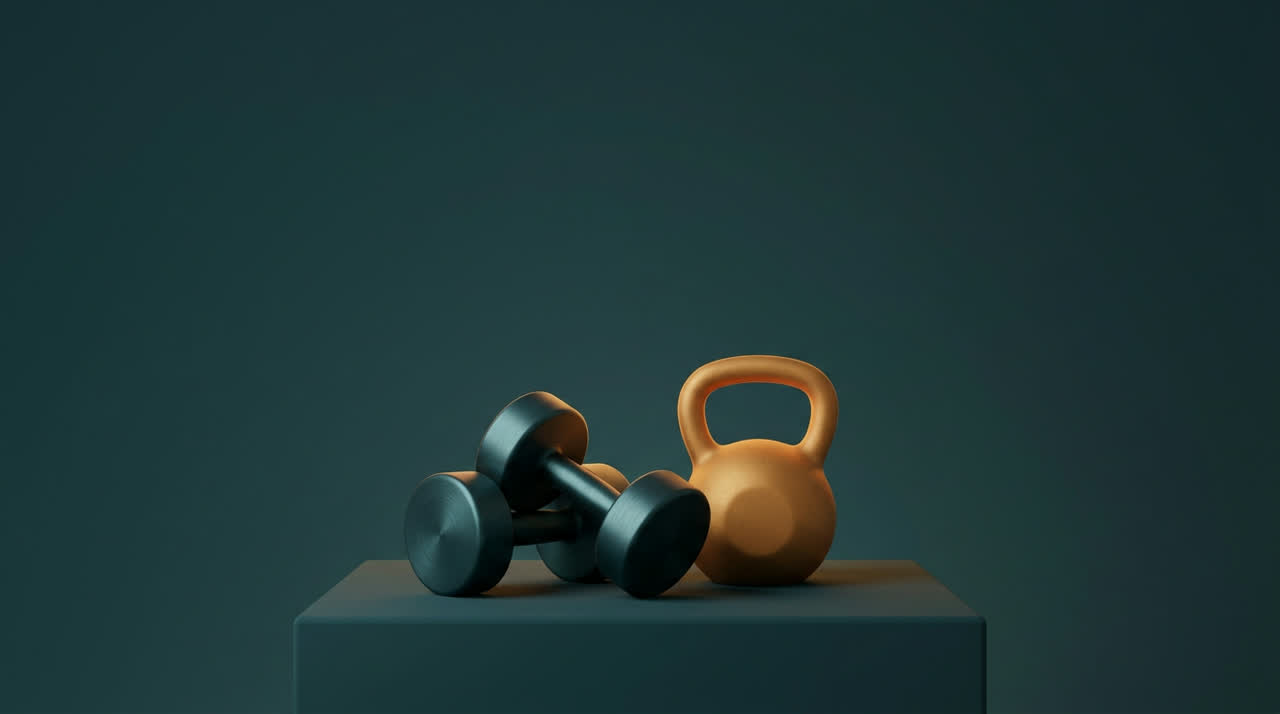
Home Gym Over 40: What You Actually Need — and What You Don't
The 30-second answer
You need less than the ads claim: a mat, a resistance band set and a pair of adjustable dumbbells cover most of a complete strength program — often for under €300. What matters is not the device but whether it lets you increase effort over time. The most expensive mistake is trying to buy motivation: equipment you don't use is too expensive at any price.
The key points at a glance
| Area | Evidence | Statement |
|---|---|---|
| Do you need equipment at all? | B | Not to start — bodyweight training demonstrably builds strength and muscle. Equipment matters once exercises get too easy: it makes progression possible in small steps. |
| Adjustable dumbbells | A | The most versatile training tool per euro: one pair replaces a whole rack, covers pushing, pulling, legs and hips, and grows with your strength for years. |
| Resistance bands | A | Cheap, joint-friendly, travel-proof — and in studies they build strength comparably to conventional weights when effort is matched. The best first purchase under €30. |
| Pull-up bar (doorway) | B | Great for the back and pulling pattern — but honestly: pull-ups are too hard for most beginners over 40. With bands for assistance, the bar becomes usable early anyway. |
| Vibration plates & EMS gadgets | — | The "training without training" myth: for EMS, effects show up mainly in supervised study settings, and the plate alone is simply not training without active exercises on it. Neither replaces progressive effort. |
| Treadmill or exercise bike | C | Only worthwhile if you genuinely use it (weather, safety, knees). Walking and running outside are free — indoor machines earn their price only once your calendar proves cardio happens indoors. |
Evidence grades: A = strongly supported · B = supported in the right context · C = emerging/mixed evidence · D = experimental · — = no proven benefit. Quoted statements with a regulation number are officially reviewed health claims authorised by the EU — we use only those.
The core principle: equipment buys progression, not motivation
Your muscles don't know what you're holding — they respond to effort close to fatigue and to rising demands over weeks. Measure every purchase against exactly that: does this device let me get stronger in small steps? A €500 machine that does one exercise at one fixed difficulty loses against a €25 band set with five strengths. And the uncomfortable truth first: no purchase creates consistency. If sticking with it is your real issue, our article on habits will help you more than any order.
The essentials: 3 things, under €300
- Training mat (from ~€20): your base for planks, core and mobility — and the lowest entry barrier: rolling out the mat is half of starting the session.
- Resistance band set with several strengths (from ~€25): rows, presses, legs, shoulders — and assistance for exercises that are still too hard. Often the gentlest start for joints, because tension is lowest at the weakest point of the movement.
- Adjustable dumbbells (from ~€120–250 depending on system): the real long-term buy. One pair covering e.g. 2–24 kg replaces dozens of single dumbbells and carries you from your first row to weighted squats and deadlifts.
Optional fourth piece: a doorway pull-up bar (from ~€25) — usable even for beginners with band assistance. A complete full-body program needs nothing more; our app works with exactly these patterns, including variants that need no equipment at all.
What you don't need (yet)
This list is longer than the shopping list — and saves you four figures:
- Multi-gyms and machine stations: expensive, space-hungry, and they train fixed paths instead of movements. Only sensible once basics and consistency have been in place for months.
- Vibration plates: standing on it is not training — without active exercises on the plate you lose exactly the progressive effort that muscle growth depends on.
- EMS home devices: under supervised study conditions there are measurable effects; as an unsupervised couch gadget the evidence is thin — and it does not replace progressive effort.
- Smart mirrors & subscription machines: you pay permanently for content that doesn't know you individually. Money for the device, subscription fatigue included.
- Specialty gadgets (ab trainers, shake weights, "muscle belts"): whenever the promise is "results without effort", the answer is always no.
What to look for when buying — especially over 40
- Adjustable dumbbells: check the locking mechanism (pin or twist-lock must audibly engage) and look for small weight increments — 2 kg steps are kinder to joints than 5 kg jumps. And don't take a brand-new system over your face — save bench and overhead presses until the locking mechanism has proven itself. Tendons adapt more slowly than muscles; small steps over 40 are strategy, not timidity.
- Bands: buy sets with several strengths plus a door anchor; briefly check for tears before each session (snapping bands are the most common injury source in band training).
- Doorway bar: test it with full weight while your feet still touch the ground — and only on solid door frames with proper trim.
- Shoes & clothing: for strength training at home, flat firm soles or bare feet are enough — special "training shoes" are dispensable in the living room. Running shoes are their own science and will get their own article.
The honest buying order
Week 1: buy nothing — do two bodyweight sessions. If you complete them, buy the mat and bands. After four weeks of showing up, buy the adjustable dumbbells — as a reward for proven consistency, not as an advance on it. That way progress finances the equipment, never the other way round. And if joints, back or existing conditions are a factor: brief medical check first, order second — the order applies here too.
One honest addition to close, because it fits our line that equipment does not replace consistency: a 2025 meta-analysis (20 studies, people with type 2 diabetes) found that gym-based strength training improved long-term blood sugar control — unsupervised home training did not, significantly. That is not a reason to drop home-gym plans; it is a pointer to what actually matters: not the equipment on the shelf, but fixed appointments, a plan with progression and, when in doubt, some guidance (app, video, coach) that keeps "unsupervised" from turning into "unstructured".
Sources
- 1. WHO Guidelines on physical activity (2020): strength training ≥2 days/week for adults — Accessed on: 2026-08-25
- 2. Lopes et al. (2019): Elastic resistance vs. conventional weights — systematic review & meta-analysis (comparable strength gains) — Accessed on: 2026-08-25
- 3. Schoenfeld et al. (2021): Loading recommendations — light and heavy loads both build muscle when effort is matched — Accessed on: 2026-08-25
- 4. Iversen et al. (2021): No Time to Lift? — time-efficient strength training with minimal equipment (review) — Accessed on: 2026-08-25
- 5. Kemmler et al. (2018): Whole-body electromyostimulation — effects mainly in supervised study settings (review) — Accessed on: 2026-08-25
- 6. Bärg et al. (2025): Effects of home- and gym-based resistance training on glycemic control in patients with type 2 diabetes mellitus — systematic review & meta-analysis (20 studies) — Accessed on: 2026-08-26
Dietary supplements are not a substitute for a balanced, varied diet and a healthy lifestyle. This article is for information purposes only and does not replace medical advice.