
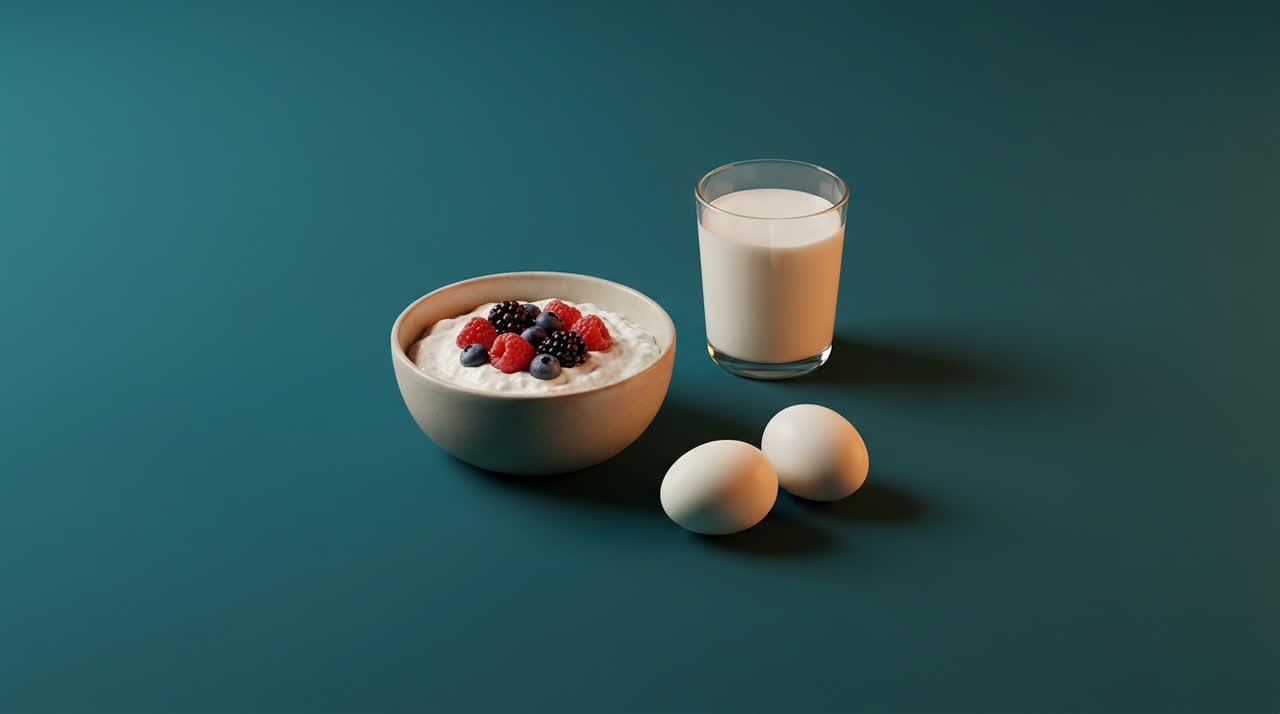
High-Protein Breakfast: 10 Fast Options With 25+ Grams
The 30-second answer
For most people, breakfast is the lowest-protein meal of the day — rolls, cereal and jam often add up to less than 10 g. If you train, that wastes the easiest lever there is: a protein-rich first meal spreads your daily intake better, keeps you full longer, and costs no extra time once you know the right moves.
The key points at a glance
| Area | Evidence | Statement |
|---|---|---|
| Better protein distribution | B | Muscle uses protein best in several solid portions across the day rather than one evening load — breakfast is the slot almost everyone is missing. A recent RCT (2025) puts the meal count itself into perspective: 3 versus 5 protein meals per day made no difference at matched daily totals — what matters is the amount per portion, not a magic number of meals. |
| Morning satiety | B | In studies, protein is usually more filling per calorie than carbs or fat — a protein-rich breakfast noticeably shrinks the 10 a.m. cravings for many. No weight-loss promise: without an overall deficit nothing happens. |
| “Breakfast is mandatory” | — | Myth: if you are not hungry in the morning, you do not have to eat — the daily total decides. This article is for people who WANT to have breakfast and want more out of it. |
| Do you need pricey specialty products? | — | No. Quark, eggs, skyr and legumes beat every “high protein” branded product on price per gram — the specialty products are convenience, not necessity. |
Evidence grades: A = strongly supported · B = supported in the right context · C = emerging/mixed evidence · D = experimental · — = no proven benefit. Quoted statements with a regulation number are officially reviewed health claims authorised by the EU — we use only those.
The starting point: the 8-gram breakfast
Two rolls with jam: about 8 g of protein. A bowl of cornflakes with milk: similar. If you aim for 1.2–1.6 g of protein per kg of body weight (see our protein guide), you would then have to cram the rest into two giant meals. The more relaxed solution: 25–40 g already in the morning — after that, perfectly normal portions at lunch and dinner are enough.
The 10 options (with approximate protein numbers)
- 1. The 2-minute classic: 250 g low-fat quark + berries + 1 tbsp oats — ~32 g. Too tart? A splash of milk and cinnamon.
- 2. Skyr bowl: 300 g skyr + banana + nuts — ~33 g.
- 3. Scrambled standard: 3 eggs + 50 g cottage cheese stirred in + wholegrain bread — ~30 g.
- 4. Overnight oats, upgraded: 50 g oats + 150 g quark + milk, overnight — ~28 g, zero morning effort.
- 5. The shake for the rushed: 30 g whey + 300 ml milk + banana — ~34 g. Powder is food, not magic (more in the protein article).
- 6. Savoury cottage cheese: 200 g cottage cheese + tomato + wholegrain bread — ~28 g.
- 7. Vegan — tofu scramble: 200 g firm tofu (crumbled, fried with turmeric and salt) + wholegrain bread — ~26 g.
- 8. Vegan — protein porridge: 50 g oats + 30 g pea-rice protein powder + soy milk — ~33 g.
- 9. Meal-prep frittata: 6 eggs + vegetables + 100 g feta baked on Sunday, 3 portions for the week — ~25 g/portion, good cold.
- 10. The leftovers confession: last night's dinner. Lentil curry or chicken with rice at 7 a.m. feels odd — and is usually the most nutritious “breakfast” on this list.
The gram numbers are everyday guides (products vary) — the point is the order of magnitude, not the decimal.
Three practical levers that make the difference
- The anchor trick: the same default breakfast on workdays (option 1 or 4) — decisions cost willpower, routines don't. Variety belongs to the weekend.
- Milk instead of water: wherever liquid goes in (porridge, shake, coffee), milk or soy milk quietly adds 7–10 g per 250 ml — the day's most silent protein supplier.
- Prepare the night before: overnight oats mixed, quark bowl set, eggs boiled — the 25-gram breakfast is built in three calm evening minutes, not in morning stress.
Who this matters for most
Everyone who trains — and doubly so in a calorie deficit, where protein protects muscle. From midlife onwards the morning slot earns its keep: the body responds a little more sluggishly to protein stimuli, and evenly sized solid portions help. An isotope study (RCT 2025) in adults over 60 confirms the principle: here too, the daily total beats timing — breakfast is simply the most convenient place to fit that total in, not a must at any cost. With kidney disease or a medically prescribed diet, as always: align protein amounts with your doctor or dietitian.
Sources
- 1. Mamerow et al. — Even protein distribution and muscle protein synthesis — Accessed on: 2026-08-21
- 2. Leidy et al. — The role of protein in weight loss and maintenance (Am J Clin Nutr 2015) — Accessed on: 2026-08-21
- 3. Morton et al. — Total protein intake and resistance training (meta-analysis, BJSM 2018) — Accessed on: 2026-08-21
- 4. Sievert et al. — Breakfast and weight: meta-analysis of randomised trials (BMJ 2019) — Accessed on: 2026-08-21
- 5. RCT (2025) — 3 vs. 5 protein meals per day at matched totals: no difference — Accessed on: 2026-08-26
- 6. Isotope RCT (2025) — daily protein total beats timing in adults over 60 — Accessed on: 2026-08-26
Dietary supplements are not a substitute for a balanced, varied diet and a healthy lifestyle. This article is for information purposes only and does not replace medical advice.